
Effective Scoliosis Therapy in Sydney Physiotherapy
Scoliosis shouldn't be a journey of uncertainty. Whether you're managing a new diagnosis or seeking relief from long-term asymmetry, we provide the clinical clarity and specialised exercises you need to stand tall and move with confidence.
With scoliosis affecting approximately 1 in 40 children and millions of adults, it is a condition that is often discovered by chance but can quickly become a source of uncertainty. Whether it’s a recent diagnosis in an adolescent, a curve that has progressed into adulthood, or the chronic discomfort associated with spinal asymmetry, scoliosis can feel like a "wait-and-see" sentence.
At Vantage Point Physiotherapy, we don’t believe in just watching. We provide a clear, evidence-based roadmap using Physiotherapy Scoliosis-Specific Exercises (PSSE). Our goal is to move you from uncertainty to a place of "Confident Recovery”; giving you the "why" behind your curve and the tools to actively support your spine’s health.
Expert Guidance for Every Stage of Growth
We understand the impact scoliosis can have—from the self-consciousness of postural changes to the physical limitations of back pain and stiffness.
Our team, led by APA Titled Musculoskeletal Physiotherapists, focus on empowering patients through:
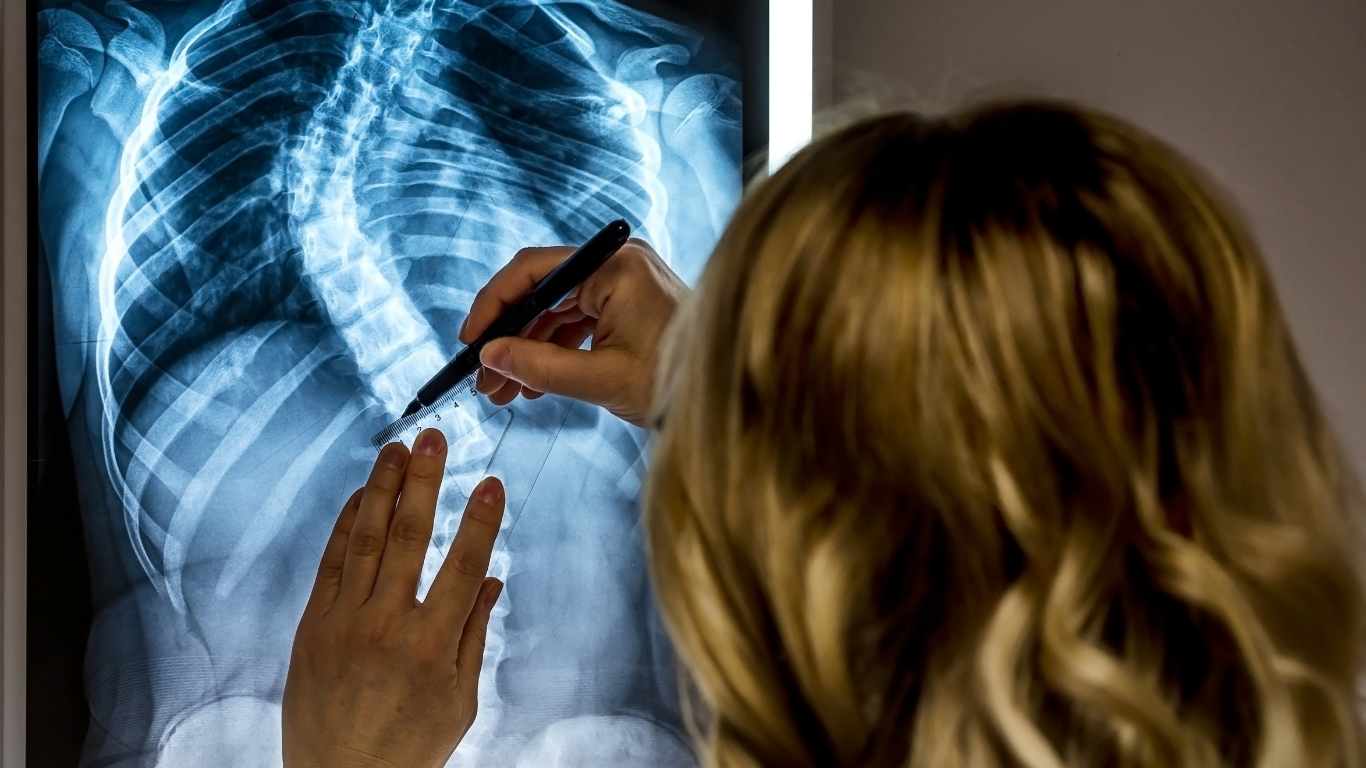
Precision Curve Analysis: A deep-dive assessment of your specific curve pattern, including radiological review (Cobb angle) and postural mapping.
3D Corrective Exercise: Tailored PSSE programs designed to promote spinal de-rotation, elongation, and symmetry.
Postural Integration: Helping you "internalise" your corrected posture so it becomes a natural part of how you sit, stand, and move every day.
Collaborative Management: We work closely with leading spinal specialists and orthotists if bracing or surgical consultation is required, ensuring your care is seamless and supported.
What is Scoliosis?
Scoliosis is a three-dimensional deviation of the spine with the involved vertebrae shifted laterally, deviation of their sagittal position, and rotation of the vertebrae backwards on the convex side. Diagnosis is made when the angle between the most tilted vertebrae involved in the curve is more than 10 degrees, also known as the Cobb angle.
There are many curve profiles within the scoliosis diagnosis, with progression affected by many factors including age, gender and activity involvement. The risk of progression is increased relative to the degree of the curve and onset age.
How is Scoliosis Diagnosed?
A group of researchers discussed the ‘vicious cycle’ concept. This concept promotes the idea of a triggering event that precipitates the asymmetrical loading of the spine, resulting in asymmetrical growth of the vertebrae, wedging of the vertebrae and hence an ever-increasing spinal curvature. Simply speaking, a small curve can eventually lead to a larger curve due to gravity and spinal mechanics alone, especially during the growth phase.
In previous generations, school based screening tests were used in the identification of students who were likely to have scoliosis. Multiple studies in the USA and Netherlands, found that this method of screening led to moderate harmful actions, including unnecessary bracing and referrals to orthopaedic surgeons. The conclusion of these studies highlighted the harms of screening for asymptomatic adolescents with scoliosis exceeded the potential benefits.The challenge within primary care is differentiating adolescents with higher-risk scoliosis requiring intervention from those lower-risk scoliosis requiring observation and no intervention.
Clinical examination of scoliosis mainly consists of Adam’s forward bend test, which assesses the symmetry of the back from behind and beside the patient. This can be quantified using an inclinometer that assists the practitioner to determine whether patients may need further radiological investigation. Generally, an angle of trunk rotation less than 5 degrees is insignificant, whilst measurements of 5 to 9 degrees warrants a six-monthly review. A measurement of 10 degrees or more requires radiological evaluation for cobb angle measure.
Types of Scoliosis
Scoliosis isn’t a one-size-fits-all condition. It can present at different stages of life and for different reasons—each type requiring a tailored approach to treatment.
-
Idiopathic scoliosis accounts for around 80% of all scoliosis cases, most commonly developing during adolescence (ages 10–18). The cause is unknown, but research suggests a combination of genetic, hormonal, and growth-related factors. It typically presents as a spinal curve to the side, often with rotation, and is more common in females. Early detection during growth periods is important to monitor progression and guide treatment.
-
Congenital scoliosis results from spinal malformations that occur during foetal development, such as incomplete formation or fusion of vertebrae. It’s usually diagnosed in infancy or early childhood, often during routine checks or if asymmetry is noticed. This type may progress as the child grows and often requires close monitoring by a specialist team. Treatment can include physiotherapy, bracing, or referral for surgical consultation in more complex cases.
-
This type of scoliosis occurs as a secondary effect of underlying neuromuscular conditions such as cerebral palsy, muscular dystrophy, spina bifida, or spinal cord injury. Poor muscle tone and lack of control around the spine can lead to progressive and more complex curvature. Management typically involves a team approach, including physiotherapy, mobility support, and referral for orthotic or surgical input when necessary. Our physiotherapists focus on posture, mobility, and function within the individual’s capabilities.
-
Also known as de novo scoliosis, this form appears later in life, typically over the age of 50, and is caused by age-related wear and tear on the spine. Contributing factors include disc degeneration, facet joint arthritis, and spinal instability. Adults may experience lower back pain, stiffness, or nerve-related symptoms like sciatica. Physiotherapy can help improve mobility, manage symptoms, and support spinal alignment, especially in conjunction with medical or specialist care.
-
Syndromic scoliosis is associated with broader medical conditions or genetic syndromes such as Marfan syndrome, Ehlers-Danlos syndrome, Rett syndrome, and neurofibromatosis. The spinal curvature is often part of a wider pattern of musculoskeletal or connective tissue issues. Because these cases can be complex, treatment often involves a multidisciplinary team. Physiotherapy plays a key role in managing posture, mobility, and maintaining function alongside medical or surgical input.
The Vantage Point Approach to Confident Scoliosis Management
At Vantage Point, we move beyond generic back exercises. Scoliosis is a three-dimensional condition, and it requires a three-dimensional solution. Our management philosophy is rooted in Physiotherapy Scoliosis-Specific Exercises (PSSE), a specialised branch of care designed to empower you to actively influence your spinal health.
Our APA Titled Musculoskeletal Physiotherapists provide a structured, four-pillar management plan:
Comprehensive 3D Assessment
We begin by establishing your clinical "Vantage Point." This involves a detailed review of your medical history, recent X-rays (Cobb angle analysis), and a physical assessment of your spinal rotation and postural symmetry. We don't just look at the curve; we look at how it affects your breathing, movement, and daily comfort.
Corrective 3D Exercise (PSSE)
Using evidence-informed methods (such as the Schroth and Rigo-BSPTS concepts), we teach you specific movements designed to:
De-rotate: Address the twist in the spine, not just the side-to-side curve.
Elongate: Use specialised breathing techniques to expand collapsed areas of the ribcage.
Stabilise: Strengthen the deep spinal muscles in a corrected position to maintain your "new normal."
Bracing & Collaborative Care
For adolescent patients where bracing may be indicated, we don't work in a vacuum. We act as your clinical advocate, collaborating with Sydney’s leading orthotists and spinal surgeons to ensure your brace is fitting correctly and your exercise program is complementing your bracing schedule.
Long-Term Autonomy & Education
Our ultimate goal is to move you from "patient" to "expert." We provide you with the knowledge and tools to manage your curve throughout your life; whether that means navigating a growth spurt, staying active in sports, or managing adult-onset discomfort.

Get a Clearer Perspective on Your Recovery.
Scoliosis shouldn't be a journey of uncertainty. Reclaim your posture and your confidence with a management plan built for your specific curve. Let’s shift your perspective from managing a condition to mastering your movement.