Evidence-based care at Vantage Point
Back Pain Physiotherapy in Bondi Junction
Assessment and treatment for back pain, sciatica and scoliosis, with a clear explanation of what is going on and a plan built around movement and strength.
- APA Musculoskeletal Physiotherapists
- Scoliosis assessment and exercise programs
- A focus on complex and athletic spine care
Symptom profiles
Which best describes your symptoms?
Back pain presents in distinct ways, and each profile points to different structures and a different starting point for treatment. Select the one closest to yours.
Localised Low Back Pain
Pain across the lower back or to one side, without symptoms travelling below the knee. Certain movements, positions or activities reliably bring it on.
You might notice
- Pain bending to put on shoes or lift the washing
- Stiffness first thing in the morning or after sitting
- Pain that eases once you get moving
What is usually happening
Most back pain is mechanical: the joints, muscles and tissues around them have become sensitive to load. Changes on scans are common in people with no pain at all, so a scan rarely explains back pain on its own. Pain that changes with movement and position is a helpful sign, because the load can be adjusted and your back retrained to handle it (Brinjikji et al., 2015).
Common causes
Mechanical low back pain
The most common presentation: pain that changes with movement, posture and load, without one structure being solely responsible.
Facet joint pain
Pain from the small joints at the back of the spine, often one-sided, stiff in the morning and worse leaning backwards.
Muscle spasm and strain
Sudden pain after lifting, twisting or a long day, with protective spasm. Most acute episodes settle over days to weeks.
Sacroiliac joint pain
Pain low in the back and buttock, where the spine meets the pelvis.
What we look at in your assessment
Movement in every direction, joint and muscle testing, hip mobility and strength, and screening for anything that needs a medical opinion.
How treatment usually starts
Reassurance and staying active, hands-on treatment and dry needling where it helps settle pain, then progressive strengthening for your back, hips and trunk.
Related services
Back Pain Radiating into the Leg
Symptoms that travel from the back into the buttock, leg or foot. This may be pain, but pins and needles, numbness or weakness can also occur on their own. This is often called sciatica.
You might notice
- Pain below the knee, sometimes worse than the back pain
- Pins and needles or numbness in the leg or foot
- Pain with sitting, coughing or sneezing
What is usually happening
When a nerve root in the lower back is irritated, by a disc or by narrowing around a joint, symptoms are felt along that nerve's path into the leg. The pattern of your symptoms often tells us which level of the spine is involved.
Common causes
Disc-related sciatica
A disc bulge or herniation irritating a nerve root, the most common cause in younger and middle-aged adults.
Spinal stenosis
Narrowing around the nerves, more common in older adults, with leg pain or heaviness on walking or standing that eases when you sit or bend forward.
Referred joint pain
The facet and sacroiliac joints can refer pain into the buttock and thigh without involving a nerve. Unlike nerve root pain, it does not cause pins and needles, numbness or weakness, and it usually stays above the knee, so telling the two apart changes the plan.
What we look at in your assessment
A neurological exam of strength, reflexes and sensation, nerve tension tests such as the straight leg raise and slump test, and close monitoring for any change. We refer for imaging only when your findings call for it.
How treatment usually starts
Positions and movements that ease your leg symptoms, gentle nerve mobility and staying active, then strength as symptoms settle. If symptoms worsen or weakness develops, we refer promptly.
Related services
Stiffness and Age-Related Changes
Back stiffness and aching, often worse in the morning or after rest, in people who have been told they have arthritis or “wear and tear”.
You might notice
- Stiffness on getting up that eases once you are moving
- Aching after standing or walking for a long time
- A scan report that mentions degeneration or arthritis
What is usually happening
Disc and joint changes are a normal part of ageing, and they are common in people with no back pain at all. The changes are real, but they do not decide how your back feels or what you can do, and strength and movement can improve at any age.
Common causes
Spinal osteoarthritis
Age-related change in the facet joints, with stiffness that usually eases with movement.
Degenerative disc changes
Loss of disc height and hydration with age. Very common, and often painless.
Inflammatory back pain
Conditions such as axial spondyloarthritis (including ankylosing spondylitis) cause back pain with morning stiffness lasting more than 30 minutes, usually starting before age 45 and easing with exercise rather than rest. If we suspect it, we refer you to your GP or a rheumatologist for testing.
What we look at in your assessment
Movement, strength and walking tolerance, balance, and a review of your scans in the context of your symptoms.
How treatment usually starts
Regular movement, progressive strengthening and a plan for the activities you enjoy, with hands-on treatment to ease stiffness. VALD testing tracks your strength over time.
Related services
Back Pain in Athletes
Back pain that comes on with sport or training, in teenagers and adults alike, especially in sports with repeated bending, twisting or impact, such as fast bowling, gymnastics, football, rowing and golf.
You might notice
- Pain leaning backwards or arching the back
- Pain that builds during training and lingers afterwards
- One-sided low back pain in a teenager who plays a lot of sport
What is usually happening
In growing athletes, repeated bending backwards and twisting load the back of the vertebra, which can lead to a stress fracture. In adult athletes, disc-related pain and joint overload are more common, often after a spike in training. Either way, persistent back pain in an athlete needs a proper assessment rather than rest and hope.
Common causes
Spondylolysis
A stress fracture of the pars interarticularis, a common cause of persistent low back pain in adolescent athletes.
Spondylolisthesis
A forward slip of one vertebra on the one below, which can follow spondylolysis.
Disc-related pain
More common in adult athletes, particularly in rowing, golf and lifting, where repeated bending and rotation load the discs.
Muscle and joint strain
Overload from a spike in training, often settling quickly with load management.
What we look at in your assessment
Your training load and technique, movement and pain on extension testing, VALD testing of hip and trunk strength with balance testing on force plates arranged offsite when needed, and referral for imaging when a stress injury is suspected.
How treatment usually starts
Load management and a modified training plan agreed with your coach, progressive trunk and hip strengthening, and a graded return to sport based on milestones.
Related services
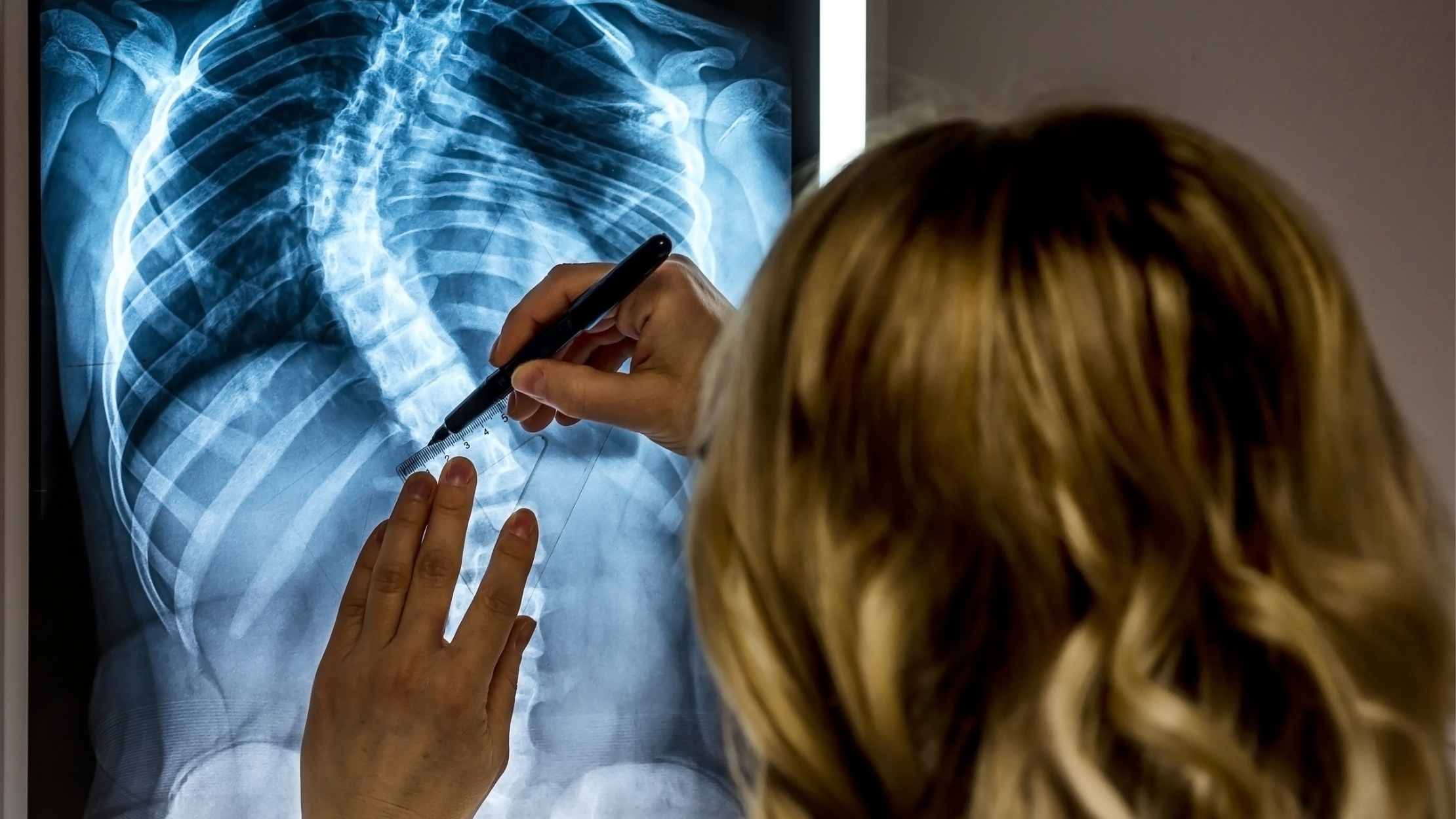
A Curve in the Spine
A diagnosed scoliosis, or a curve or rib hump noticed by you, a parent or a doctor. We see scoliosis at every age, from a first diagnosis in a teenager to long-term management in adults.
You might notice
- One shoulder or hip sitting higher than the other
- A rib hump when bending forward
- Back pain or fatigue linked to the curve
What is usually happening
Scoliosis is a three-dimensional curve of the spine with rotation, diagnosed when the curve measures 10 degrees or more on an X-ray (the Cobb angle). Most cases appear during the teenage growth spurt with no known cause, so monitoring during growth matters most. In adults, a curve can also develop as the spine ages.
Common causes
Adolescent idiopathic scoliosis
The most common type, appearing during growth without a known cause.
Congenital scoliosis
A curve caused by vertebrae that formed differently before birth.
Neuromuscular scoliosis
A curve linked to a condition affecting the nerves or muscles.
Adult-onset (degenerative) scoliosis
A curve that develops later in life as the discs and joints change.
What we look at in your assessment
Trunk rotation measured with a scoliometer in the forward bend test, a review of your X-rays and Cobb angle, and posture and movement assessment repeated over time so changes are clear.
How treatment usually starts
For children and teenagers: monitoring through growth spurts, scoliosis-specific exercises to improve posture control and help reduce the risk of progression, and working with your specialist and orthotist when a brace is needed. For adults: treatment for pain and stiffness linked to the curve, and strength and endurance for work, sport and daily life.
Related services
Recovery After Spinal Surgery
Rehabilitation before and after spinal surgery, including discectomy, decompression, fusion, disc replacement and scoliosis correction, starting when your surgeon advises.
You might notice
- Stiffness and guarding after your operation
- Uncertainty about which movements are safe
- Wanting to get back to work, sport or lifting
What is usually happening
After surgery, the tissues need time to heal, and the muscles around your spine often switch off and lose strength. A staged program rebuilds that strength safely. Exercise programs starting 4 to 6 weeks after lumbar disc surgery reduced pain and disability in the short term more than no treatment, and did not increase the rate of repeat surgery (Oosterhuis et al., 2014).
Common surgeries
Discectomy and microdiscectomy
Removal of the part of a disc pressing on a nerve, usually followed by a staged return to activity.
Decompression (laminectomy)
Surgery to create more space around the nerves, most often for spinal stenosis.
Spinal fusion
Surgery to join two or more vertebrae, with movement limits set by your surgeon in the early weeks.
Disc replacement
An artificial disc that keeps movement at that level, with its own early precautions.
Scoliosis corrective surgery
Correction of the curve, with or without fusion, followed by a long, staged return to activity and sport.
What we look at in your assessment
Your surgeon's protocol, a movement and neurological check, and baseline strength testing.
How treatment usually starts
Before surgery, prehab builds strength and prepares you for recovery. Afterwards, walking and gentle movement come first, then staged strengthening within your surgeon's limits, progressed by measured milestones. Where longer-term conditioning would help, we work collaboratively with exercise physiologists.
Related services
Neck pain or headaches? See neck pain physiotherapy.
Understanding your pain
A Scan Is Not the Whole Story
Most back pain is not caused by serious damage, and many of the changes seen on scans are just as common in people with no pain at all.
We screen for the rare signs of something more serious and arrange imaging when the result would change your plan. Then we explain what we find in plain language, because understanding your pain is part of treating it.
What scans show in people with no back pain
Disc degeneration
Disc bulge
Share of people without back pain whose scans showed each finding (Brinjikji et al., 2015).
Disc herniations often shrink on their own
How often each type had shrunk on a later scan
The larger the herniation, the more likely it was to shrink without surgery (Chiu et al., 2015).
Your treatment
Five Steps, Each With a Clear Goal
Every consultation is 45 minutes. Your plan is built around what matters to you, whether that is sleeping through the night, sitting through a workday or getting back to sport.
- 1
Assess
A detailed history and physical examination, including screening for anything that needs a medical opinion.
Goal: A clear diagnosis
- 2
Explain
What is causing your pain, what to expect, and which activities are safe to keep doing.
Goal: Confidence to keep moving
- 3
Settle
Hands-on treatment, dry needling where it helps, and changes to your activity to calm things down.
Goal: Pain under control
- 4
Strengthen
Progressive exercise for your back, hips and trunk, with VALD testing to track your strength.
Goal: Strength targets met
- 5
Stay well
A long-term program and a flare-up plan, so you know what to do if pain comes back.
Goal: Managing on your own
Cortisone injections
Where Cortisone Injections Fit
Cortisone (corticosteroid) injections are sometimes recommended for back pain or sciatica. They aim to calm inflammation around an irritated nerve or joint, but research shows the benefit is usually small and short-lived, so they work best as part of a wider plan rather than on their own.
We do not give injections ourselves, but we often see people who are considering one, and we work with the GP, sports physician or specialist who provides it.
For sciatica
A small, short-term benefit
Across 25 trials, epidural cortisone injections slightly reduced leg pain and disability for up to 3 months compared with a placebo injection. The effect was smaller than what most people would notice as a meaningful change (Oliveira et al., 2020).
For back pain without sciatica
Not enough evidence either way
A review of 18 trials found no strong evidence for or against injections for ongoing low back pain, although some people may still respond (Staal et al., 2008).
How we work with injections
Buying time to do the rehab
Any relief from an injection is usually short-term, so we treat it as a window: time bought to build strength, movement and confidence while your pain is lower. We plan your rehabilitation around the injection so you are better prepared when its effect wears off.
The research
What the Research Tells Us
In Australia
Back pain is common
About 4 million Australians, around 1 in 6, reported back problems in 2017–18, and back pain was the second leading cause of disease burden in Australia in 2015 (AIHW).
Imaging
Early scans did not improve recovery
Across 6 trials with 1,804 people, having a scan straight away for low back pain without warning signs did not improve pain or function in the short or longer term (Chou et al., 2009).
Guidelines
Education and staying active come first
International guidelines recommend education, staying active and exercise as first-line care, with careful use of medication, imaging and surgery (Foster et al., 2018).
Exercise
Exercise reduced persistent back pain
A review of 249 trials found exercise reduced chronic low back pain by about 15 points on a 100-point scale compared with no treatment, usual care or placebo, a clinically important difference (Hayden et al., 2021).
Scoliosis bracing
Bracing reduced curve progression in teenagers
In teenagers with higher-risk curves, 72% of those braced finished growing without their curve reaching the surgical threshold, compared with 48% of those observed, and more hours in the brace gave better results (Weinstein et al., 2013).
Scoliosis exercise
Guidelines support scoliosis-specific exercise
International scoliosis guidelines recommend scoliosis-specific exercises to help reduce the risk of progression during growth, alongside bracing when it is needed (Negrini et al., 2018).
A scan shows the structure of your spine. It does not show how strong, mobile or confident you are. That is why we measure what you can do and build your plan around it.
Fees and funding
Consultations and Rebates
Every consultation is 45 minutes. The number of consultations you need depends on your pain and your goals, so we discuss your plan with you at your first visit.
Book an AppointmentWays to claim
- Private health: rebates claimed on the spot with HICAPS
- Medicare: rebates with a GP referral
- Workers compensation: fees set by SIRA, with approvals coordinated with your case manager
- CTP: fees set by SIRA
Common Questions
Do I need a scan before I see a physio?
Usually not. Most back pain can be assessed and treated without imaging, and having a scan straight away does not improve recovery when there are no warning signs (Chou et al., 2009). If your assessment suggests a scan would change your plan, or we find signs that need a medical opinion, we arrange it through your GP or specialist.
Should I get a cortisone injection for my back?
It depends on your symptoms, and it is a decision for you and your doctor. Research shows the benefit is usually small and short-term (Oliveira et al., 2020), so if you do have one, we use the period of lower pain to build strength and movement. We are happy to talk it through with you and your GP or specialist.
Should I rest or keep moving?
In most cases, keep moving. Guidelines recommend staying active and returning to normal activities as you are able (Foster et al., 2018). We show you which activities are safe and how to adjust them while your pain settles.
When should I see a doctor urgently?
Seek urgent medical care if back pain comes with loss of bladder or bowel control, numbness around the groin or inner thighs, worsening weakness in your legs, fever, or pain after a significant fall or accident.
How many sessions will I need?
It depends on your pain, how long you have had it and your goals. We give you an estimate at your first visit and review it as you meet each step's goal.
Can physiotherapy fix scoliosis?
Exercise cannot reliably straighten a curve, but scoliosis-specific exercise is recommended to help reduce the risk of progression during growth and to improve posture, pain and function (Negrini et al., 2018). Growing teenagers with larger curves may also need a brace, and we work alongside your specialist and orthotist.
Do you see children and teenagers with scoliosis?
Yes. We see children and teenagers at every stage, from a first diagnosis through growth spurts and bracing. A parent or guardian attends appointments with patients under 18, and we keep your GP, specialist and orthotist updated.
Can I claim my physio through private health?
Yes. Rebates are claimed on the spot with HICAPS. Medicare rebates are available with a GP referral, and workers compensation and CTP claims are accepted once approved.
What research is this page based on?
The studies referenced on this page are listed below.
- Australian Institute of Health and Welfare. Back problems. Canberra: AIHW. Accessed October 2026.
- Brinjikji W, Luetmer PH, Comstock B, Bresnahan BW, Chen LE, Deyo RA, Halabi S, Turner JA, Avins AL, James K, Wald JT, Kallmes DF, Jarvik JG. Systematic literature review of imaging features of spinal degeneration in asymptomatic populations. AJNR Am J Neuroradiol. 2015;36(4):811–816.
- Chiu CC, Chuang TY, Chang KH, Wu CH, Lin PW, Hsu WY. The probability of spontaneous regression of lumbar herniated disc: a systematic review. Clin Rehabil. 2015;29(2):184–195.
- Chou R, Fu R, Carrino JA, Deyo RA. Imaging strategies for low-back pain: systematic review and meta-analysis. Lancet. 2009;373(9662):463–472.
- Foster NE, Anema JR, Cherkin D, Chou R, Cohen SP, Gross DP, et al. Prevention and treatment of low back pain: evidence, challenges, and promising directions. Lancet. 2018;391(10137):2368–2383.
- Hayden JA, Ellis J, Ogilvie R, Malmivaara A, van Tulder MW. Exercise therapy for chronic low back pain. Cochrane Database Syst Rev. 2021;9(9):CD009790.
- Negrini S, Donzelli S, Aulisa AG, Czaprowski D, Schreiber S, de Mauroy JC, et al. 2016 SOSORT guidelines: orthopaedic and rehabilitation treatment of idiopathic scoliosis during growth. Scoliosis Spinal Disord. 2018;13:3.
- Oliveira CB, Maher CG, Ferreira ML, et al. Epidural corticosteroid injections for lumbosacral radicular pain. Cochrane Database Syst Rev. 2020;4(4):CD013577.
- Oosterhuis T, Costa LOP, Maher CG, de Vet HCW, van Tulder MW, Ostelo RWJG. Rehabilitation after lumbar disc surgery. Cochrane Database Syst Rev. 2014;(3):CD003007.
- Staal JB, de Bie R, de Vet HCW, Hildebrandt J, Nelemans P. Injection therapy for subacute and chronic low-back pain. Cochrane Database Syst Rev. 2008;(3):CD001824.
- Weinstein SL, Dolan LA, Wright JG, Dobbs MB. Effects of bracing in adolescents with idiopathic scoliosis. N Engl J Med. 2013;369(16):1512–1521.
- Clinically reviewed by David Cohen and Zachary Ehrenfeld, APA Musculoskeletal Physiotherapists and Directors of Vantage Point Physiotherapy. Last reviewed October 2026.